Saturday, December 28, 2013

WBW 2013 Community Outreach in Bonamikano

By Helen Ayamba, Email: camlink99@gmail.com
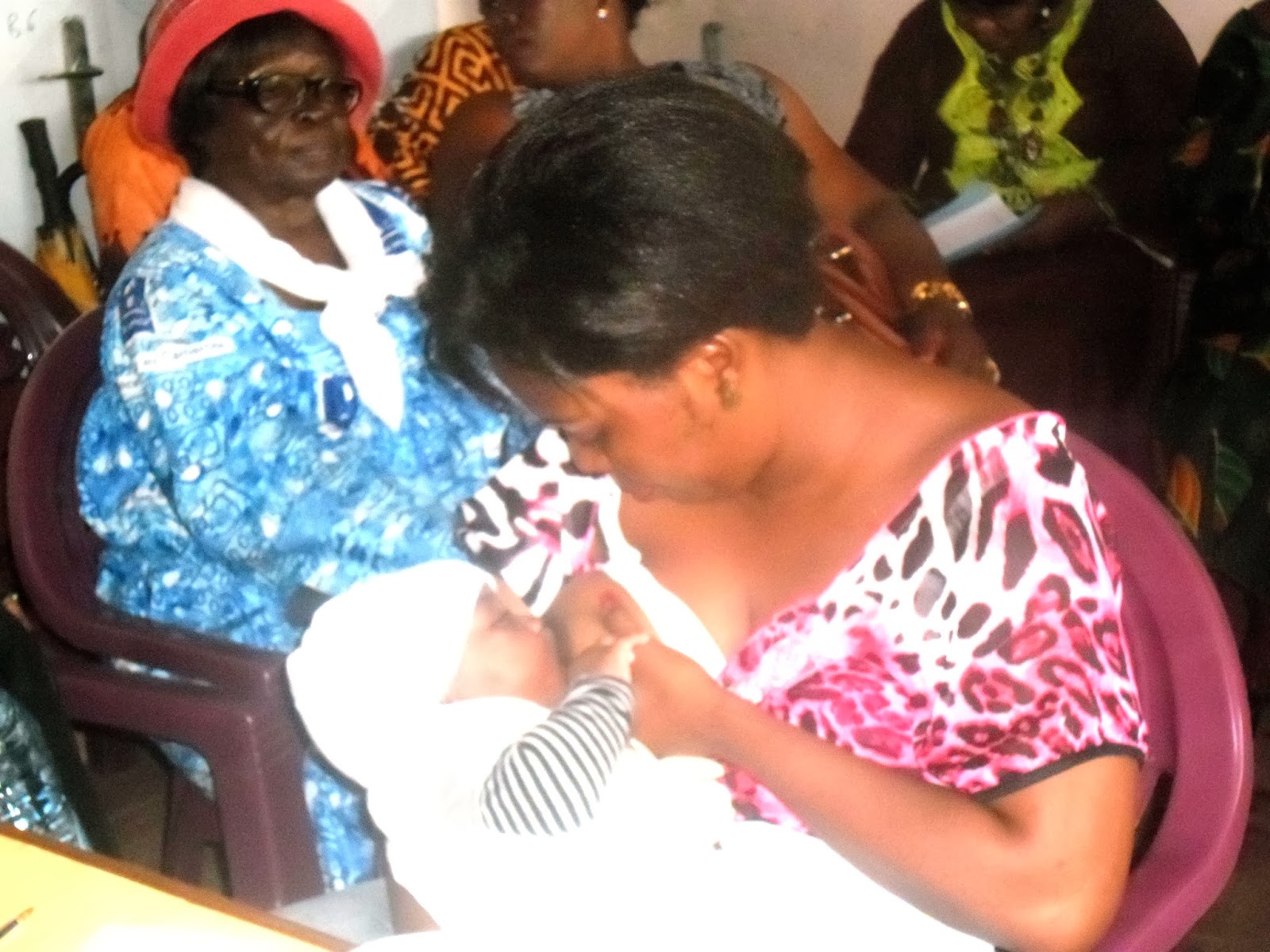
WBW 2013 activities in Bonamikano were organized by the Women Gender and Development Council (COGESID). This is a community based organization situated in a typically Douala traditional health area. COGESID Bonamikano is one out of six women gender and development councils created eight years ago with a CIDA seed grant for gender promotion by Cameroon Link. The CBO has been involved in WBW activities since its creation. The health area stretches to the banks of River Wouri with a small population living in a nearby island. Social mobilization and sensitization was piloted by Emma Mouto Priscille, who heads the CBO and is a member of FECABPA. She was assisted by other members of the national network, Londo Lobe, Benaimou Carole and a supervisor from the regional delegation of public health. The population of Bonamikano co-habit with a relatively large moslem community and this called for sensitization of the mother in the French, Douala and Toupouri local languages. The facilitators shared advice on good practice and the advantages of breastfeeding, emphasizing the importance of early initiation of breastfeeding within the first hour after delivery of a baby. Benaimou Carole talks about the physiological, economic and social impact breastfeeding has on a mother, family and the community as a whole. Water and other liquids were discouraged as part of the food of the baby before six months, because breastmilk contains enough water.
Answering questions on the number of times a baby needs to be breastfed, Priscille Mouto said, breastfeeding should on demand around the clock. Hygiene practice is very important and mothers were advised to wash their hands regularly before giving their breasts to their babies. Mothers were advised not to drink alcohol during breastfeeding, because it reduces the quality of breastmilk intake by the baby. A restitution of the educative talk by the mothers was organized and this permitted for distribution of T-shirts, exercise books and soap to all the participants. A family photo was taken to highlight the memories of the interactive session at Bonamikano.A member of ACMS used the opportunity to address the issue of family planning, adding that intensive practice of breastfeeding is also a method of contraception. Local language broadcasters attended the educative talk and used materials collected for animation of programmes in the Douala local language. 79 women and 6 men took part in the educative talk, social mobilization and sensitization campaign in Bonamikano.

WBW 2013 In Littoral Region of Cameroon

By Helen Ayamba, Email: camlink99@gmail.com
The briefing workshop in the littoral region was presided over by the delegate for public health, Dr. Martin Yamba, who lauded the presence of several health workers, leaders of nutrition organisations, journalists, men and women of radio and television of the public and private as well as the print media. He told the audience that the celebration of the WBW 2013 was moved from August to a later period for convenience of proper preparation to impact on a wider population throughout Cameroon. He added that the briefing aimed at reiterating the total engagement of the ministry of public health and the government to make exclusive breastfeeding and mother support a reality within all communities. All stakeholders are involved, so that the message can go across for good practice that gives babies their right to breastmilk exclusively for the first six months after delivery, with complimentary feeding thereafter and continued breastfeeding upto 24 months and beyond. Dr. Yamba observed that the theme of the WBW 2013 calls the attention to the need to support breastfeeding mothers. Fathers and partners of the mothers were invited to exercise their roles to facilitate action within the families and communities. He concluded by saying that the mode in our society is to see mothers attached to their babies and breastfeed them. Breastfeeding should be an obligation of all mothers for the promotion of child survival in Cameroon, the regional delegate emphasized. He invited the nutrition associations to carry out social mobilization and sensitization activities throughout health areas by reaching well organized groups of men, women and youths.
After the official opening, Marie Hostense Koe, the focal point for nutrition in the littoral presented a brief history of the world breastfeeding week and contributions made by Cameroon since 1991 including demographic surveys and the putting in place of the national code. She presented activities planned before, during and after the WBW after elaborating on the objectives of the celebration in 2013, which included the increase of support for mothers, so that they can practice breastfeeding optimally, the promotion of awareness at all levelson the need and value of providing support to breastfeeding mothers, sharing of essential information to peers, who are partners, health care providers, midwives, family and friends on the protection, promotion and support of breastfeeding. It was also an opportunity for the President of FECABPA to explain the role played by members of the national network in raising awareness about the existence of the decree No. 01 Dec.2005/5168/PM regulating the marketing of breastmilk substitutes. From the briefing workshop, members of FECABPA were deployed in Mambanda, Grand Hangar, Nkomba, Bonaminkano, Bonassama and New Bell health districts and health areas. Special programmes were realized on Sweet FM and CRTV, while the president of FECABPA was guest of the News Round Up on Canal 2 Tv and other media. Cameroon Link Radio produced a series broadcast programmes uploaded on its online radio station. Articles were also published on the camlinknews blog and camlink youtube channel.
While the associations appreciated the quantity and quality of materials produced this year, they regretted the low financial support compared to the 2012 WBW celebration which stood at CFA 100.000 per community based organisation for IEC and social mobilisation action. They appealed that the funding agencies should increase the support grant, considering that the number of actions on the field have increased.

WBW 2013 Heavy Community turnout in Lebialem

By Peter Monet Otto FFF Cameroon
73 mothers were sensitized during the world breatfeeding week celebration in Lebialem. The event was presided over by the District Health Medical Officer, Dr. Angu Gideon at Azi-Lebang. Participants at the sensitization workshop came from Njentse, Fonge,batibo, nkah, Mankem, Bellua, Mbindia, njenbetu, Njeh, M’mockmbie, Fongo-tonou, Ndungateh, Agongazi, Atusah, Ndoungalleh. Esso Attah, Ndonweh, Nveh and Azi health areas. To start, prayers were led by Mariana Ajengeh, a nursing mother who called on the Almighty lord to guide all the nursing mothers and their children present and those that did not have the opportunity to be at the Azi District Hospital. Dr. Angu Gideon made an opening address to explain the significance of the celebration, informing the mothers that the staff of the hospital is available at all moments to give advice on breastfeeding in cause of difficulties.Emmanuel Atangah, Secretary of Achenadia Development Association (ADA) and member of FECABPA, was delegated as focal point to assist as facilitator with Mrs. Mbu Diana, mid wife of the hospital, who is also a member of Fine Forest Foundation (FFF Cameroon). member. MBu Diana recalled past events in the health district as she presented her lecture on exclusive breastfeeding for the first six months, its advantages to the mother and the child. Emmanuel Atangah highlighted the key messages delivered during the official launching in Yaoundé and the regional briefing workshop which took place in Buea. It was observed that the Nweh women are so attached to the tradition of breastfeeding and that bottle feeding is very uncommon. Lebialem is described as the Switzerland of Cameroon with one thousand hills and valleys. This explains why the FECABPA Focal Point for the South West region regretted the very high cost of transportation of the materials to Lebialem on a very bad muddy road from Dschang. The transport fare from Dschang to Azi-Lebang, venue of the celebration was CFA 7.500, which three times the normal rate.
The population is rural and the main activity is agriculture and animal breeding. Due to the bad roads, evaluation of food crops is difficult and the people do not buy breastmilk substitute because the money is not available. Lebialem Community Radio covered the celebration and produced two live shows of one hour each and a special programme on breastfeeding. FFF Cameroon handed some materials to the radio station for the animation of the interactive live shows. The 25 social mobilizers received two thousand (2.000) Frs CFA. each for their transports and door-to-door home visits, to counsel mothers that could not go to the hospital with their babies due to long distances. The participants were appreciative of the amount of materials made available this year for the celebration.
Difficulties encountered: The road from Dschang to Azi is very bad and transportation was very difficult and costly, as passengers trekked long distance to allow the driver go out of difficult patches of the road. The President of FECABPA was guest of the special programme on Lebialem Community Radio to explain why the government and UNICEF decided to invest so much in 2013 for the breastfeeding movement and reasons for the delay in celebrations, because materials needed to be printed. T-shirts, soaps and exercise books were distributed to mothers, while the Cameroon Code on the marketing of breastmilk substitute was handed to health workers with campaign posters. It was recommended that the seed grant and support should be increased in future because Lebialem has a very difficult topography which makes community outreach on the field difficult.

WBW 2013 In South West Region of Cameroon

By Emma Atangah in Buea,
World Breastfeeding Week 2013 briefing activity in Buea, the south west region of Cameroon was presided over by the regional delegate, Dr. Mbome Njie Victor, who started by explaining why the launching in Cameroon was late and not in the month of August, like in other parts of Africa. Dr. Mbome said, it was to permit preparation of the outreach materials produced by UNICEF, so the social mobilization and sensitization activities would reach many more women for impact. All stakeholders had to be involved in the campaigns after the regional workshops. The regional delegate observed that in the past years, the lack of awareness of the population has contributed to the rate of breastfeeding remaining low in Cameroon. Support of breastfeeding mothers is a multi-sectorial action and all of us should take part for results to be visible. He concluded by suggesting that to increase breastfeeding rates, the government should initiate the creation of breastmilk banks in health facilities, to care for babies, whose mothers did not have the opportunity to breastfeed. The creation of milk banks start with education of the nurses and midwives and the organization of public awareness campaigns, so mothers can donate their milk to save lives freely. The regional focal point for nutrition in the south west, Epie Kepche Gerard, revealed that in the last demographic survey of 2011, the region registered 7.212 cases of chronic malnutrition in children spread in the different health districts. Epie Gerard drilled the over 30 participants at the workshop on what they should know about breastfeeding, What the world breastfeeding week is all about, why Cameroon organizes the event each year, the objectives of the celebration, key programmed activities before, during and after the celebration. Cameroon focused attention on three of the five circles for multisectoral action, which include family and social networks, health care systems, work place and employment.
According to the EDS-MICS 2011 survey, Cameroon recorded 122% under five deaths, with one out of three deaths due to inadequate breastfeeding practices. He added, that with the application of good breastfeeding practices, a good start in the child’s life can be guaranteed, especially when practiced exclusively. Cameroon’s target is to increase breastfeeding rates to 50% by the year 2025. Since UNICEF reprinted the national code on the marketing of breastmilk substitute, emphasis was put on monitoring on the health facilities and marketing strategies put in place by the companies. The nutrition focal point told the media, that articles should be published on company bad practices which include penetration of health facilities, distribution of promotional gadgets and dumping. The President of FECABPA, James Achanyi-Fontem, used the opportunity of the briefing in Buea to talk about the challenges of breastfeeding and the strategy put in place to overcome the many challenges mothers and their communities face. He made a call for the involvement of youth because of the increasing number of teen mothers in Cameroon. Most of the girls are not prepared for a pregnancy and when it happens, they are also not prepared for breastfeeding their babies. He added that the preparation for successful breastfeeding starts from the period the woman gets pregnant and start pre-natal consultations and counseling in the health facility. It is during this period that the expectant mother is given all the necessary information and advice on how to face breastfeeding challenges. A big challenge is the misinformation of mothers who successfully birth their babies in some health facilities. The health workers introduce artificial breastmilk substitutes because of the tips and gadgets received from formulae manufacturing companies due to the number of brands competing in our markets. This is causing mothers not to respect one of the 10 conditions, which requires that the mother stays in the health facility with the baby for 48 hours before re-integrating the community. It is during this period that the health worker and midwife have to encourage the mother to initiate early breastfeeding, so the baby can benefit from the positive effects of colostrum.
The workshop in Buea talked about the Cameroon Code because it was observed that most health workers are ignorant of the existence of this tool, which guides against abuses and violation of the right to appropriate food for the baby. The code forbids the penetration of health facilities by company delegates to push the brands of their infant formulas. Short films on the first 1000 days of the life of the baby were projected to highlight some of the required approaches during counseling of mothers. From the regional breastfeeding workshop, activities were taken to the health district level and communities for organization of social mobilization and sensitization of mothers at grassroots. The lectures were presented in pidgin and the local languages for greater spread and outreach of mothers. Testimonies by mothers were registered during the question and answer sessions. Taboos were explained and advice given was necessary.

Friday, December 27, 2013

WBW 2013 Witnesses Great Participation In Cameroon

By James Achanyi-Fontem, PCA,FECABPA Email: fecabpa@gmail.com
Cameroon decided to delay the effective launching of World Breastfeeding Week 2013 for several reasons including the search for greater participation and impact from all stakeholders. This impact was achieved through orientations made in policy and investment by the ministry of public health, WHO, UNICEF, IBFAN Africa and other stake holders. The several tripartite preparatory meetings held in Yaoundé, capital of Cameroon focused on issues which aimed at closing gaps, following the report card presented after the second breastfeeding trends initiative assessment (WBTi)conducted by the Regional Coordinator of IBFAN Africa, Joyce Chanetsa and orientations on the way forward drawn from the first World Breastfeeding Conference (WBC) In New Delhi, India. The outcome of the WBTi Cameroon keep officials worried about why so much efforts is made, but exclusive breastfeeding rate remained so low at 20%. The first decision by the Minister of Public Health, Andre Mama Fouda, was to decentralize WBW activities nationwide at grassroots with involvement of lactating mothers, health workers and rural community radio stations to spread the key messages in local languages.
44 community based organizations and 60 community radio stations across Cameroon were engaged in WBW activities. The coordination of the activities was placed in the hands of the Federation of Cameroon Breastfeeding Promotion Associations, FECABPA. The federation led by Cameroon Link now officially plays the role of a national breastfeeding committee following a collaboration protocol agreement signed with UNICEF Cameroon on the instruction of the minister of public health. It should be noted that Cameroon Link is the leading civil society organization piloting IBFAN Cameroon Group activities due to a long standing connection and collaboration with the World Alliance for Breastfeeding Action (WABA) and the International Baby Food Action Network (IBFAN Africa). The government’s policy orientations led to the production of more social mobilization and sensitization materials for the WBW 2013 in addition to the large packs received from WABA and IBFAN Africa in English and French languages. These materials with the theme of the WBW 2013 were used for producing programmes in the official and local languages. To listen to the programmes, click on the web links at the end of this report. Materials produced locally included press packs, reviewed national code on the marketing of breastmilk substitutes, exercise books and T-shirts with the WBW 2013 logo placed on them. These items served for motivation of mothers and broadcasters during the educative talks, social mobilization, sensitization and organization of radio quiz on the theme for the year. UNICEF distributed several thousand pieces of soap during the week within its WASH on-going campaign as part of the hygiene ethics for mothers to wash their hands regularly before breastfeeding their babies.

Soutenir l’allaitement aux côtés des mères

Par Mbarga Honorine,AFFE, MENGUEME , Pont So’o Mbalmayo (Association des Femmes et Filles Entreprenantes)
L’Association des Femmes et des Filles Entreprenantes (AFFE) de MENGUEME dans le département du NYONG et SO’O a toujours militée pour l’allaitement maternel et nous le défendons. Ce premier mode de nutrition de l’Etre Humain, a souvent fait au sein de notre communauté l’objet de plusieurs débats dans les familles lorsque qu’une jeune femme met au monde son tout premier bébé. Allaiter ou non son bébé? Quelles sont les raisons qui peuvent amener certains membres de la communauté à penser que l’allaitement soit négatif pour la jeune mère ? Quel est bien fondé de l’allaitement maternel pour notre bébé ? Forts de ces interrogations et dans le but de sensibiliser avec le soutien de tous nos partenaires, nous partons chaque année malgré les moyens insuffisants mis à notre disposition, apporter le soutien possible aux familles pour qu’elles puissent pratiquer l’allaitement maternel de façon optimale. D’où la descente que nous venons une fois de plus d’effectuer dans le département du NYONG ET SO’O plus précisément dans les Arrondissements de MBALMAYO et de MENGUEME. ACTIVITEES MENEES DANS LA VILLE DE MBALMAYO
1. Elaboration des communiqués radio en langues Béti à radio femme FM de Mbalmayo 2. Causeries éducative sur l’allaitement maternel avec les sages femmes et les mères à la maternité principale de l’hôpital chinois de Mbalmayo. 3. Entretien avec le personnel du service de sante de l’arrondissement de Mbalmayo sur l’allaitement. 4. Le proviseur du lycée bilingue de Mbalmayo soutient l’allaitement maternel et nous sommes invités à souvent venir de temps en temps dans son lycée pour s’entretenir avec les élèves sur l’allaitement maternel. Activités menées dans l’arrondissement de Mengueme 1. A l’école publique de pont SO’O, nous avons sensibilisé les élèves ensuite nous leurs avons posé quelques questions sur l’allaitement maternel avant de distribué les cahiers à ceux qui ont donné des réponses justes. 2. A l’école catholique de MVAM-BOT qui nous a réservée un accueil chaleureux. Nous avons sensibilisé les enseignants et les élèves sur l’importance de l’allaitement maternel et après nous avons fait des petits jeux concours. Les meilleurs ont gagnés des prix. 3. Apres les écoles primaires nous nous sommes rendus à l’hôpital catholique de MVAM-BOT pour donner au personnel soignant quelques techniques nécessaires pour mettre en œuvre une bonne pratique de l’allaitement maternel. 4. Le 19 novembre 2013, une réunion de sensibilisation et de promotion de l’allaitement maternel, a eu lieu à la grande salle de fêtes de la Mairie de MENGUEME. Réunion au cours de laquelle nous avons informé les autorités traditionnelles et les cercles de soutien à prendre conscience de l’importance à accorder aux mères qui allaitent.
En conclusion, Il était question pour nous de sensibiliser la communauté des arrondissements de MBALMAYO et de MENGUEME à soutenir, encourager et promouvoir l’allaitement maternel. Nous avons également encouragé les mamans à adopter l’allaitement maternel qui est la nutrition par excellence pour leurs bébés. Cela c’est fait sans trop de difficultés car le matériel mis à notre disposition était suffisant. Par contre nous avons éprouvé des difficultés au niveau du déplacement. Et nous souhaiterons que dans l’avenir ces moyens soient améliorés pour que nous puissions couvrir tous le département.

WBW 2013 In North West Of Cameroon

By Kingsley Andang, Nutrition Focal Point
According to the EDS-MICS 2011 survey, Cameroon recorded 122‰ under five deaths, with one out of three deaths due to inadequate breastfeeding practices. However, applying good breastfeeding practices guarantee a good start in the child's life, especially when it is practiced exclusively for the first six months as recommended by UNICEF, WHO and MOH. Reducing the number of under 5 deaths and juvenile diseases is therefore a development factor taken into account the overall objectives of the WHO which stipulate that the rate of exclusive breastfeeding during the first 6 months must be at least 50 % by 2025 Demographic and Health Surveys (DHS) conducted from 1991 to 2011 showed a progressive rise in the rate exclusive breastfeeding up to six months between 1991 and 2004. cameroon noticed a drop from 2006 to 2011 with only 20% of children exclusively breastfed.The progressive rise observed up to 2004 can be explained by the setting up of the National Breastfeeding Policy validated in 1994 by the Minister of Public Health and the sensitization of communities and Health staff during the World Breastfeeding Weeks (WBW). Cameroon joined the rest of the international community to celebrate the World Breastfeeding Week (WBW), 2013 edition. A week of activities in which all those involved in the child and mother health are working hard to attract the attention of the population on the importance of breastfeeding. The activities of this 21th edition of the World Breastfeeding Week with the theme " Breastfeeding Support: Close to mothers " will place particular emphasis on providing ongoing support to the breastfeeding mothers from her immediate environment, and those around her.
GENERAL OBJECTIVE The main goal of World Breastfeeding Week 2013 is to increase support to mothers so that they can practice optimal breastfeeding. SPECIFIC OBJECTIVES  Draw support to the importance of peer support in helping mothers to establish and sustain breastfeeding.  Provide essential information to peers (partners, grandmothers, sisters, health staff, friends……..etc.) on the protection, promotion and support of breastfeeding.  Raise awareness on the existence of Decree No. 01 Dec.2005 2005/5168/PM regulating the marketing of breast milk substitutes. METHODOLOGY  Setting up of a Regional committee to pilot the activities of the week  Preparatory meetings  Regional and press briefings  Radio talk shows and quizzes  IEC in ANCs, IWCs, Training schools for health personnel, Focus groups, Regional Delegations  Discussions/questions and answer sessions  Video projection/power point projections ACTIVITIES PROPER FOR WBW Several activities were carried out before, within and after the world breastfeeding week. Before the week A Regional Committee was set up to pilot the affairs of the Week and this committee was made up of representatives of the Associations, Representative of the Regional Delegate of Women’s Empowerment and the Family, Focal Point of Nutrition and Communication of the Delegation of Health and Presided by representative of the Regional Delegate of Public Health. (see annex for minute and attendance sheet). From its first preparatory meeting, associations were urged to establish a chronogram of activities and that a Service note sign by the Regional Delegate of Public Health instructing District Medical Officers to organize activities in their various Districts. Social mobilization materials were received from FECABPA and it was resolved that PF Nutrition and communication should make a distribution plan and effectively distribute before the commencement of the activities proper. On the occasion of the Rural Women’s Day organized by the Regional Delegation of Women’s Empowerment and the Family on the 14/10/2013 at the Bamendankwe Fon’s Palace,the region team used it as an opportunity and sensitized women’s group on breastfeeding and the important of peers to a breastfeeding mother.
During the week The last preparatory meeting was held on 8 November 2013 with stakeholders where SOCMOB materials were dispatched, financial support to the two associations and attendance and justification documents made available to the associations. • On 9 November 2013, a radio talk and a quiz were organized over radio Ndefcam and Focal Point Nutrition, Focal Point Communication, and a communicator from HEDECS as resource persons. • 13 November 2013, sensitization in two Training Schools for Health Personnel: Full Gospel Schools for Health Personnel and Training School for Midwifery Bamenda. There was powerpoint presentation on the theme, video projection and presentation on the regulation of the marketing of breastmilk substitutes in Cameroon. The keen attention and questions and answers that followed showed the interest of these future health workers on the subject. Social materials were handed to the school authorities and fliers to the students present. • 14 November 2013, sensitization, questions and answers and symbolic prizes awarded to some mothers, fathers, grandmothers and some baby- sitters at the IWC of the Regional Hospital in Bamenda. Later that day there was sensitization of leaders of women’s groups at the Conference hall of the Regional Delegation of MINPROFF presided by the Regional Delegate, where there were presentations, video presentations and questions and answers. Posters, T – shirts, fliers were distributed and these women groups opted to advocate for breastfeeding in their various groups. • Sensitization of members of the Regional Chapter of ACADIA (Cameroon Association for Diabetes) on the occasion of the world diabetes day at Nkwen Baptist centre. • 15 November 2013, sensitization of Nutrition counselors of the Nutrition Improvement Program of the CBC on the occasion of their annual evaluation meeting at the Mbingo Annex Nkwen, Bamenda. They were told to promote, protect and support breastfeeding in their various posts and as peer counselors in the community. • 16 November 2013, radio talk show and quiz over Radio Hot Cocoa with three resource persons: PF Nutrition and communication, and communicator from HEDECS. SWOT ANALYSIS For this year’s excercise, we had the following strength, weaknesses, opportunities and threats ; Strength  Involvement of the districts via the District Medical Officers and the Districts Focal Points for communications.  Full commitment and involvement of the Regional Delegation of Women’s Empowerment and the Family.  The desire expressed for the didactic talks on breastfeeding by the adminstration and students of some Training Schools for Health Personnel in the region.  Active participation of the community media in disseminating the information and the organisation of the quizzes on breastfeeding Weaknesses  Insufficient supervision of the associations involved in the exercise Opportunities  Celebration of the Rural Women’s Day was judiciously exploited to educate several women’s groups on the importance of breastfeeding.  nnual evaluation meeting of nutrition counsellors of the NIP of the CBC Health Board was exploited to emphasize the importance of breastfeeding in infant and young child nutrition.  Celebration of World Diabetes Day was also an opportunity exploited as breastfed children having lower risk of developing diabetes in later life. Threats  Several postponements of the week that somewhat lulled the zeal and enthusiasm that usually surround the week in the first week of August.  Insufficient financial package and late arrival of funds for media coverage.  Insufficient social mobilisation materials that couldnot cover all the health facilities in the 19 health districts of the region. Recommendations  Health Districts should be effectively involved in the annual event for a wider coverage and health staff at all level should be recycled in the aspects of infant and young child feeding.  Planning of the activity should be bottom-top and not the reverse.  More Media organs and National Language Broadcasters should be involved for wider sensitization.  More related sectors such as the Social Affairs, Councils, both Traditioner and Religious leaders etc should be actively involved.  Their should be the development of data collection tool that will help to have information on the indicators of breastfeeding Conclusion Despite above mentioned shortcomings and belated celebration, the activities of the world breastfeeding week 2013 in the North West region witnessed a broader spectrum and more intensified as more than ever before. During this week, many more women and men were sensitized and counselled on the benefits of optimal breastfeeding and their questions were answered. We conducted a variety of activities to reach as many women as possible, and in some local languages. With proper planning and availability of adequate resources, it is hoped that our activities in the subsequent years will yield more benefits and sustainable impacts.